Why Marketing Teams Are Breaking Free from Campaign Chaos
Agile marketing services help businesses move faster, waste less, and build campaigns that deliver by breaking big projects into small, testable steps and adjusting based on real data.
What Agile marketing services include:
- Iterative campaigns – Launch quickly, learn, and improve continuously
- Cross-functional teams – Writers, designers, and strategists working together in short cycles (sprints)
- Data-driven pivots – Change direction based on what’s working, not guesswork
- Customer-focused strategy – Build around real feedback, not internal assumptions
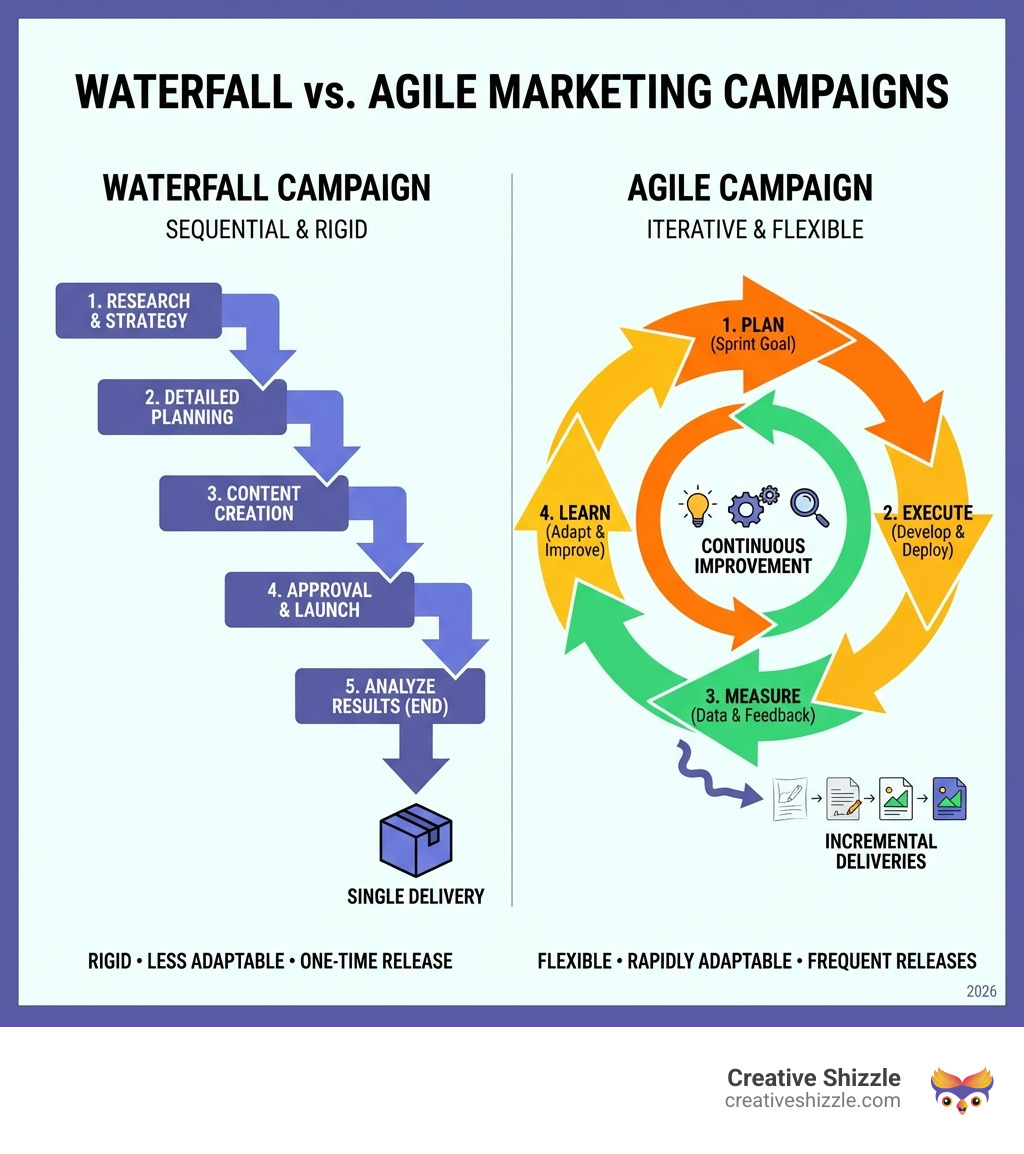
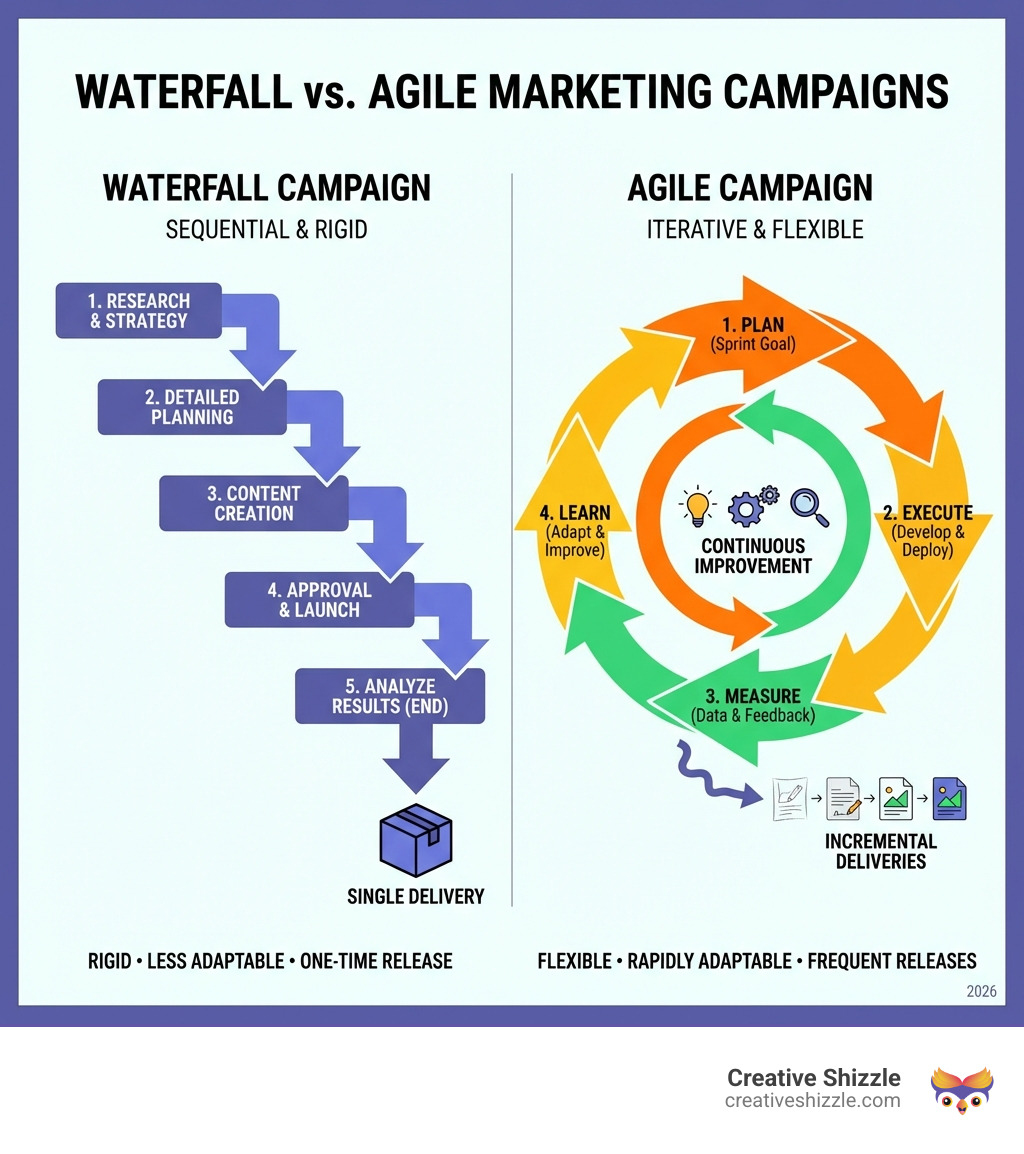
If you’re a business owner tired of watching marketing budgets disappear into long, rigid campaigns that miss the mark, you’re not alone. Traditional marketing operates like a waterfall: months of planning, a big launch, then hoping for the best. By the time you know what worked, the market has moved on.
Agile marketing flips that model. Instead of betting everything on one big campaign, you run small experiments, measure what happens, and adjust. It’s how modern software teams ship products, and it’s changing how smart marketing teams operate.
But Agile isn’t just about speed or savings. It’s about building a marketing operation that can respond to change without breaking. When a new competitor launches, a social platform shifts its algorithm, or customer preferences evolve, Agile teams adapt. Traditional teams scramble.
I’m Taylor Wilson, founder of Creative Shizzle, where we’ve spent over 20 years helping growth-stage brands build scalable marketing systems using Agile marketing services. What we’ve learned is this: the businesses that win aren’t the ones with the biggest budgets; they’re the ones that learn fastest.
From “Big Bang” Campaigns to Continuous Improvement: Defining Agile Marketing
Imagine trying to steer a dense jungle with a map drawn years ago. That’s often what traditional marketing feels like. You plan everything upfront, then execute without much deviation, hoping you hit your destination. This “waterfall” approach works well when the path is clear and unchanging, but in the dynamic world of marketing, that’s rarely the case.
What is Agile Marketing?
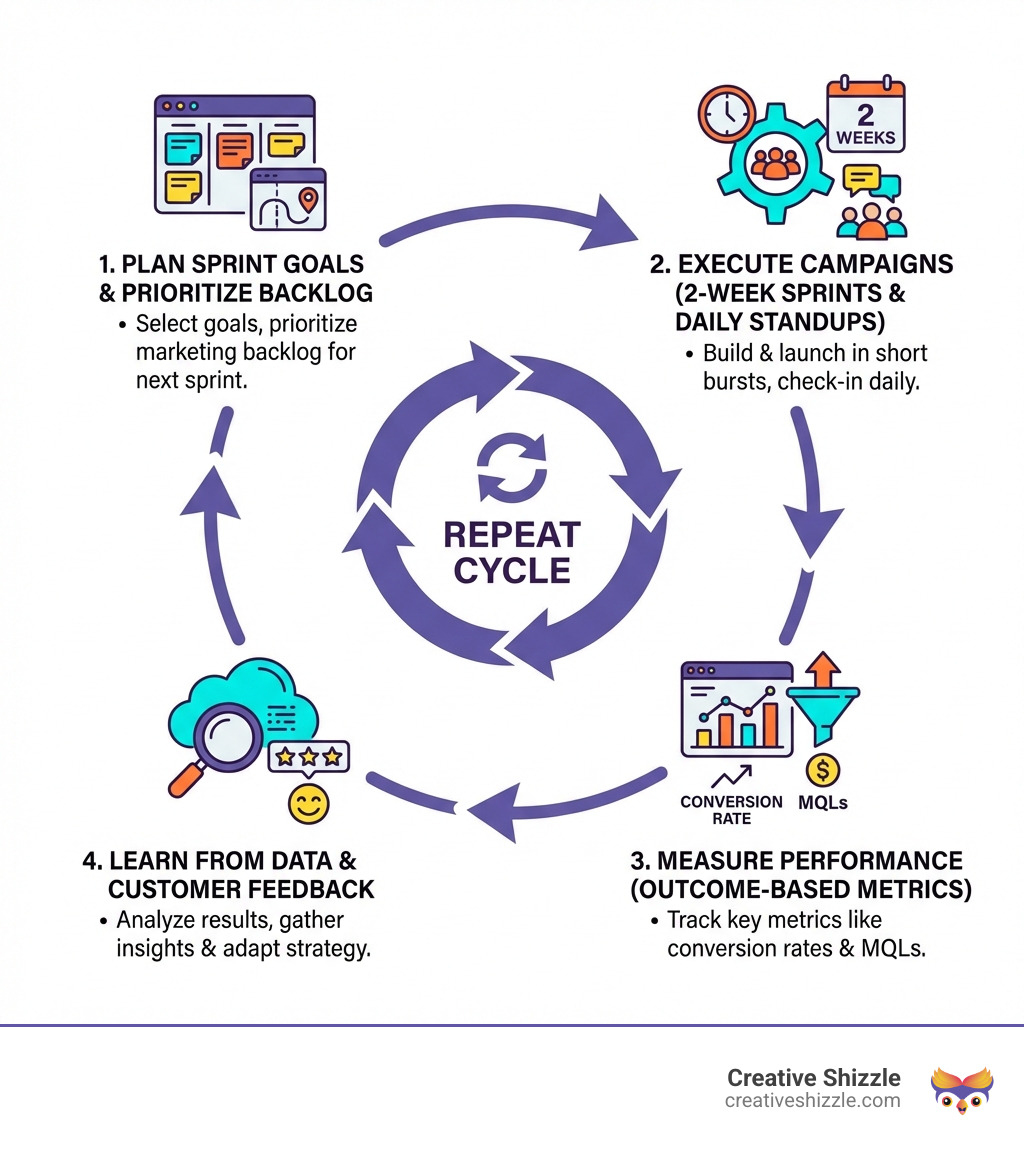
Agile marketing is an iterative, data-driven approach that prioritizes rapid experiments, continuous feedback, and quick adjustments over rigid, long-term plans. It’s about responding to change rather than following a static blueprint, launching small campaigns to test, learn, and react, promoting continuous and incremental improvement of results over time.
This approach didn’t just appear out of thin air. It originated in the software development field over 20 years ago , where teams needed to build complex products in rapidly evolving technological landscapes. The core idea was simple: instead of building a whole product in secret for months, build a small, working version, get feedback, and improve it. This continuous loop of planning, executing, measuring, and learning proved revolutionary. Marketing, facing similar pressures from the internet’s dynamic nature, adopted these principles, eventually formalizing them in the Agile Marketing Manifesto in June 2012 .
How Does Agile Marketing Differ from Traditional Marketing?
The main difference lies in how we approach planning and execution. Think of it this way:
| Feature | Traditional (Waterfall) Marketing | Agile Marketing Services |
|---|---|---|
| Planning | Detailed, long-term plans upfront | Flexible, iterative planning in short cycles |
| Execution | Linear, sequential phases | Concurrent, iterative sprints |
| Team Structure | Siloed, specialized departments | Cross-functional, self-organizing teams |
| Feedback | Infrequent, often post-campaign | Continuous, integrated throughout cycles |
| Response to Change | Difficult, costly, often avoided | Accepted, expected, and incorporated rapidly |
| Focus | Delivering a predefined output | Delivering continuous customer value and outcomes |
While traditional marketing might focus on an initial grand plan and full execution without changes, Agile marketing services emphasize frequent delivery of content, deliberate experimentation, and data-driven adjustments. We launch small to test, learn, and react, always striving for continuous and incremental improvement. It’s like starting on a road trip where you know your destination but are open to adjusting your route based on new information, road closures, or interesting detours.
The core principles and values of Agile marketing revolve around customer collaboration, responding to change, and delivering value frequently. We believe in the power of continuous feedback, strategic vision, and medium to long-term marketing planning that remains adaptable. The Agile Marketing Manifesto champions these ideas, guiding marketing teams to be more efficient, responsive, and ultimately, more successful.
The ROI of Agility: Measurable Benefits for Modern Businesses
Let’s be honest, in marketing, everyone wants to know: “What’s the return on investment?” With Agile marketing services, the ROI isn’t just a hopeful outcome; it’s a measurable reality. We’re talking about tangible improvements that directly impact your bottom line and the well-being of your marketing team.
Releasing Speed and Efficiency
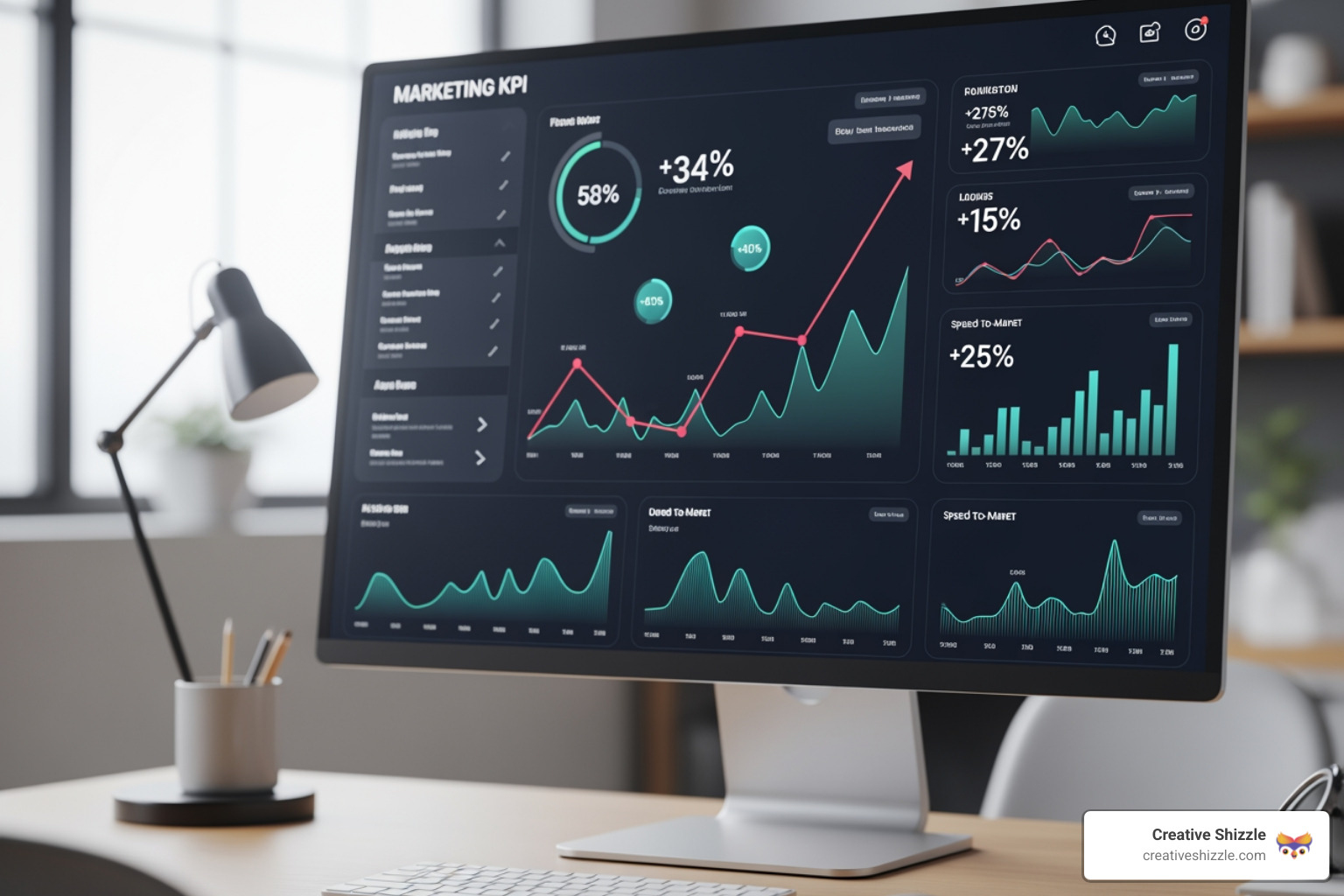
One of the most immediate benefits we see with Agile marketing is a significant increase in speed to market. Studies show teams can launch campaigns up to 40% faster . This isn’t magic; it’s the result of breaking down large initiatives into smaller, manageable chunks, allowing for quicker deployment and testing.
This rapid iteration also leads to significant savings. Organizations that adopt Agile marketing often report double-digit percentage reductions in wasted spend as they quickly stop underperforming tactics and reallocate budget to what works. Less waste means more budget for effective campaigns, and who doesn’t love that?
Boosting Team Productivity and Morale
We’ve all been there: the endless meetings, the unclear priorities, the feeling of being constantly stretched thin. Agile marketing tackles these issues head-on. When all teams are Agile, satisfaction with work management increases by 22 percentage points (source). This isn’t surprising when you consider that Agile practices like clear sprint goals and daily stand-ups bring order to marketing chaos.
This improved work environment translates directly into higher employee engagement, with some studies showing a 20-30 percentage point improvement in engagement scores . When team members feel more productive and have clearer objectives, their morale soars. This also fosters optimism that teams can take advantage of emerging opportunities, which increases by 21 percentage points when all teams are Agile (source).
Adaptability and Improved Customer Satisfaction
In today’s digital landscape, being able to pivot quickly is no longer a luxury—it’s a necessity. Agile marketing services build this adaptability into your team’s DNA. Instead of being locked into a year-long plan, you can adjust your strategy based on real-time data and customer feedback. This means your marketing efforts are always relevant and responsive to market shifts.
This continuous feedback loop directly translates to improved customer satisfaction. By constantly testing and optimizing, we ensure that the campaigns we launch truly resonate with our target audience, leading to better engagement and stronger relationships.
Who Benefits Most from Agile Marketing?
While any business can benefit from Agile marketing, certain industries and project types are particularly well-suited:
- SaaS and Tech Companies: Rapid product development cycles demand equally agile marketing to keep pace.
- E-commerce Businesses: The need for constant optimization, A/B testing, and quick campaign launches makes Agile a perfect fit.
- Regulated Industries (BFSI, Healthcare, Life Sciences): Agile helps embed compliant operations while maintaining speed and efficiency, a critical balance.
- Businesses with Complex Projects and High Uncertainty: When requirements can change quickly, Agile’s flexibility is invaluable. Think website development or large-scale content marketing initiatives.
- Growth-Stage Brands: For companies looking to scale rapidly, Agile provides the structure to do so efficiently without getting bogged down.
Agile marketing services lead to outcomes such as speed to market, waste reduction, better alignment with organizational goals, and improved customer satisfaction. It’s truly The Next Generation of Marketing, empowering marketing teams to achieve more with less.
How to Implement Agile Marketing Services: Frameworks, Roles, and Processes
Transitioning to Agile marketing isn’t just about adopting new tools; it’s about a fundamental shift in how your marketing team operates. It requires new structures, new processes, and a commitment to continuous learning. But don’t worry, we’re here to guide you through it!
The Agile Marketing Team Structure
Forget the traditional, siloed marketing department where content doesn’t talk to SEO, and SEO doesn’t talk to paid ads. In an Agile world, we build cross-functional, high-velocity teams that can tackle projects from start to finish.
Here are the key roles we typically see:
-
Marketing Lead (or Marketing Owner): This is the strategic driver. They translate business goals into clear marketing objectives, deeply understand the customer, and prioritize the backlog of marketing work. They make the final call on what gets done next so the team is always focused on the highest-impact initiatives.
-
Agile Marketing Lead (or Scrum Master for Marketing): This role is the facilitator and coach for the marketing team. They help everyone apply Agile practices, keep workflows smooth, and remove blockers that slow campaigns down. They also protect the team’s focus by minimizing distractions and helping the group continuously improve how they work.
-
The Agile Marketing Team: This is the cross-functional group that plans, creates, launches, and optimizes campaigns. Together, they hold all the skills needed to move from idea to measurable result, such as:
- Content Marketers: Writing copy, emails, landing pages, and long-form content.
- SEO Specialists: Improving search visibility and organic traffic.
- Paid Media/PPC Specialists: Managing paid search, social, and display campaigns.
- Social & Community Managers: Building engagement across social channels.
- Designers & Creative Specialists: Producing visual assets and creative concepts.
- Marketing Operations & Analysts: Managing tools, tracking performance, and turning data into insights.
The beauty of this structure is that it breaks down silos. Instead of passing work from one department to another, the team collaborates closely, ensuring seamless execution and shared understanding. Agile teams are often cross-disciplinary, customer-facing, and capable of shipping work as a unit. This is a significant deviation for agencies or internal teams used to relying solely on Account Managers for communication.
Common Agile Marketing Frameworks
While the Agile Manifesto provides the guiding principles, frameworks give us the structure to put them into practice. Two popular ones are Scrum and Kanban:
- Scrum for Marketing: This framework is ideal for teams working on complex projects with evolving requirements. It organizes work into short, time-boxed iterations called “sprints,” typically lasting 1-4 weeks, as defined by the Scrum framework .
- Sprint Planning: At the start of each sprint, the team decides which items from the prioritized backlog they can realistically complete.
- Daily Stand-ups (Daily Scrum): Short, daily meetings where each team member shares what they did yesterday, what they’ll do today, and any obstacles they face. This keeps everyone aligned and helps identify blockers quickly.
- Sprint Review: At the end of the sprint, the team demonstrates completed work to stakeholders and gathers feedback.
- Retrospective: A crucial meeting where the team reflects on the sprint, discusses what went well, what could be improved, and creates an action plan for the next sprint.
- Kanban for Marketing: Kanban focuses on visualizing workflow and limiting Work-in-Progress (WIP). It’s excellent for continuous delivery and managing a steady flow of tasks, especially for ongoing operational marketing like content production or social media management. Imagine a whiteboard with columns like “To Do,” “In Progress,” and “Done,” with cards moving across. The key is to limit how many cards can be in “In Progress” at any given time to prevent bottlenecks.
- Scrumban: As the name suggests, Scrumban is a hybrid approach that combines the structured iterations of Scrum with the visual flow and WIP limits of Kanban. It offers a flexible way to get the best of both worlds, adapting to the specific needs of a marketing team.
The Agile Marketing Workflow: From Planning to Measurement
Our Agile marketing workflow is designed to be a continuous loop of improvement. It starts with a clear strategic vision and then breaks down into actionable steps:
- Quarterly Roadmaps & Backlog Prioritization: We begin with a strategic vision and then outline quarterly marketing roadmaps. This isn’t a rigid plan, but a high-level guide. The “backlog” is a prioritized list of all marketing initiatives, campaigns, and tasks. The Marketing Owner continuously refines and prioritizes this backlog based on customer needs, business goals, and current market conditions.
- Sprint Planning & Execution: Based on the backlog, the team plans what they can achieve in the upcoming sprint. During the sprint, daily stand-ups keep everyone aligned. Our high-velocity teams, often powered by AI tools like our proprietary Scribizzle™, execute campaigns, create content, and run experiments.
- Outcome-Based Metrics & Feedback: Instead of just tracking “output” (e.g., number of blog posts), we focus on “outcomes” (e.g., increased MQLs, conversion rates, website traffic, engagement). We continuously measure the performance of our initiatives. This includes validating hypotheses: did our small experiment achieve the desired result?
- Learning & Adaptation: The Sprint Review and Retrospective are crucial for learning. We analyze the data, discuss what worked and what didn’t, and use these insights to refine our strategy and prioritize the next set of tasks in the backlog. This continuous feedback loop ensures we’re always optimizing for better results. This iterative process is also critical for things like optimizing website design, ensuring that user experience and conversion paths are continually improved. For more on this, check out Why You Need to Invest in Good Website Design.
Overcoming Common Challenges in Adopting Agile Marketing Services
It wouldn’t be an honest guide if we didn’t talk about the bumps in the road. Transitioning to Agile marketing can present challenges, but with the right approach, they are entirely surmountable.
- Leadership Buy-in: Without support from the top, any change will struggle. We address this by demonstrating the measurable ROI and efficiency gains of Agile early on.
- Resistance to Change: People are creatures of habit. Marketing teams might be hesitant to abandon familiar, albeit inefficient, processes. We overcome this by emphasizing the benefits for individual team members: more control over their bandwidth, clearer priorities, and a stronger sense of purpose.
- The “Chaos” Myth: Some mistakenly believe Agile means “no planning” or constant, erratic changes. We clarify that Agile requires more planning, just in a different, more flexible way. Structure, like sprints, is essential to manage changes effectively.
- Starting Small: Don’t try to go fully Agile overnight. We recommend starting with one project or a small team, learning from that experience, and then gradually expanding. This minimizes disruption and builds confidence.
- Providing Training and Resources: Education is key. We invest in comprehensive training to ensure everyone understands the principles, roles, and processes. Tools also play a vital role in supporting Agile efforts. There are many great options out there, including those mentioned in a list of tools for agile marketing, to help with transparency, tracking, and communication.
- Gauging Consensus: When making big changes, it’s important to ensure everyone is on board. We often use techniques like using a “fist of fives” to gauge consensus, where team members vote with their fingers (five for full agreement, one for strong disagreement) to quickly understand collective sentiment.
By proactively addressing these challenges, we can ensure a smoother, more successful transition to Agile marketing services.
Finding Your Agile Partner: What to Look for in an Agency
So, you’re convinced that Agile marketing services are the way to go. Now, how do you find the right partner to help you implement this transformative approach? Whether you’re looking to augment your internal team or fully outsource your marketing, choosing the right Agile marketing agency is crucial.
Key Attributes of a Successful Agile Marketing Agency
When evaluating potential partners, we look for agencies that embody the true spirit of Agile:
- Culture of Experimentation and Learning: A great Agile agency isn’t afraid to test, learn, and iterate. They view every campaign as an experiment designed to gather data and improve. This culture of continuous improvement is fundamental.
- Data-Driven Decisions: Opinions are great, but data is better. The best Agile agencies base their decisions on measurable results, not just intuition. They use analytics to inform every pivot and optimization.
- Transparency: Agile thrives on openness. Your agency partner should be transparent about their processes, progress, and challenges. You should feel like an integral part of their team, not just a client receiving reports.
- Collaborative Partnership: Look for an agency that sees themselves as an extension of your team. They should actively seek your input, integrate your feedback, and work alongside you to achieve shared goals.
- Flexibility and Adaptability: The world of marketing changes constantly. Your agency should be able to adapt quickly to new market conditions, technological shifts, and evolving customer preferences.
At Creative Shizzle, we pride ourselves on these attributes. We believe in building strong, collaborative relationships with our clients, rooted in transparency and a shared commitment to measurable results. Learn more about our philosophy on our About page.
Understanding Engagement and Pricing Models for Agile Marketing Services
Traditional agencies often charge based on hourly rates or fixed project fees, which can be rigid and unpredictable. Agile marketing services introduce more flexible and outcome-focused pricing models:
- Subscription/Retainer Model: This is a common approach where you pay a fixed monthly fee for ongoing services. This fosters a partnership mentality, as the agency is invested in your long-term success rather than just project-by-project delivery. It allows for flexibility in adjusting priorities within the retainer scope.
- Sprint-Based Pricing: Some agencies price engagements based on sprints. For example, a 2-week sprint might have a fixed cost, and you commit to a certain number of sprints. This provides clear budgeting for short, iterative work cycles.
- Points-Based Estimation: This model, borrowed directly from software development, estimates the effort and complexity of tasks using “story points.” Points are not a perfect translation to hours, which is important, but they’re usually close. They’re meant to be an estimation of the value and time involved per task, factoring in unknowns and risks. This helps prioritize work based on value and effort.
At Creative Shizzle, we offer subscription-based Agile marketing services, providing predictable costs and continuous value. Our pricing models are designed to be transparent and flexible, adapting to your specific needs. You can explore our Pricing to understand how we structure our engagements.
Why Partner with an Agency?
While building an internal Agile marketing team is a fantastic goal, partnering with an agency like Creative Shizzle offers distinct advantages:
- Expertise and Experience: We bring years of specialized knowledge and a proven track record in implementing Agile methodologies across various industries. This means you benefit from our collective experience without the learning curve.
- Objectivity: An external partner can provide a fresh perspective, identify blind spots, and challenge assumptions that might be ingrained within your internal team.
- Scalability: Need to ramp up quickly for a major campaign? An Agile agency can provide high-velocity teams and resources faster than hiring internally, and scale back when needs change.
- Access to Advanced Tools and AI: We leverage cutting-edge technology, including our proprietary AI tools like Scribizzle™, to automate routine tasks, uncover data-driven insights, and amplify creative output. This gives you a competitive edge without the hefty investment in licenses and training.
- CMO Leadership: Our services often include CMO-level strategic guidance, providing your business with top-tier marketing leadership without the full-time executive salary.
We’re not just an agency; we’re your strategic partner in building a marketing engine that drives real results. Our subscription-based, full-stack marketing and creative services, coupled with our flexible, high-velocity teams and AI tools, offer a powerful alternative to traditional hiring or agencies. Don’t just take our word for it—explore our Case Studies to see the impact we’ve had on other businesses.
Frequently Asked Questions about Agile Marketing
Is Agile Marketing just for large companies?
No, its principles of flexibility and focus are highly beneficial for small businesses and startups that need to be nimble and make every dollar count. Agile marketing helps organizations of all sizes prioritize high-value work, create high-performing teams, and improve speed-to-market.
Does Agile mean we don’t have a long-term strategy?
No, Agile marketing operates within a larger strategic vision. The long-term goals remain, but the path to get there is flexible and broken into smaller, manageable steps. We set a strategic direction and then use iterative sprints to steer towards it, adjusting our tactics based on what we learn along the way.
How long does it take to see results from Agile marketing?
You can see process improvements like better team communication, clearer priorities, and reduced meeting times almost immediately. Business results, like increased leads or sales, typically start to show within the first few sprints as the team begins to optimize based on data and continuous feedback. Significant ROI, such as major cost savings or substantial speed-to-market increases, often becomes evident within a year of consistent implementation, with over 70% of agile marketers reporting they see value in that timeframe .
Accept the Agile Advantage and Transform Your Marketing
We’ve explored how Agile marketing services are revolutionizing the way businesses approach their marketing efforts. From its roots in software development to its measurable benefits in terms of speed, efficiency, team morale, and ROI, Agile offers a powerful antidote to the inefficiencies of traditional marketing. We’ve seen how dedicated roles, flexible frameworks like Scrum and Kanban, and a continuous loop of planning, execution, and measurement empower marketing teams to be more responsive, data-driven, and customer-focused.
The market isn’t waiting, and neither should you. Staying competitive means embracing adaptability and continuous improvement. Are you ready to build a marketing engine that drives real results and accelerates your growth?
Explore our Agile Marketing Services and see how we can help you gain the agile advantage.