
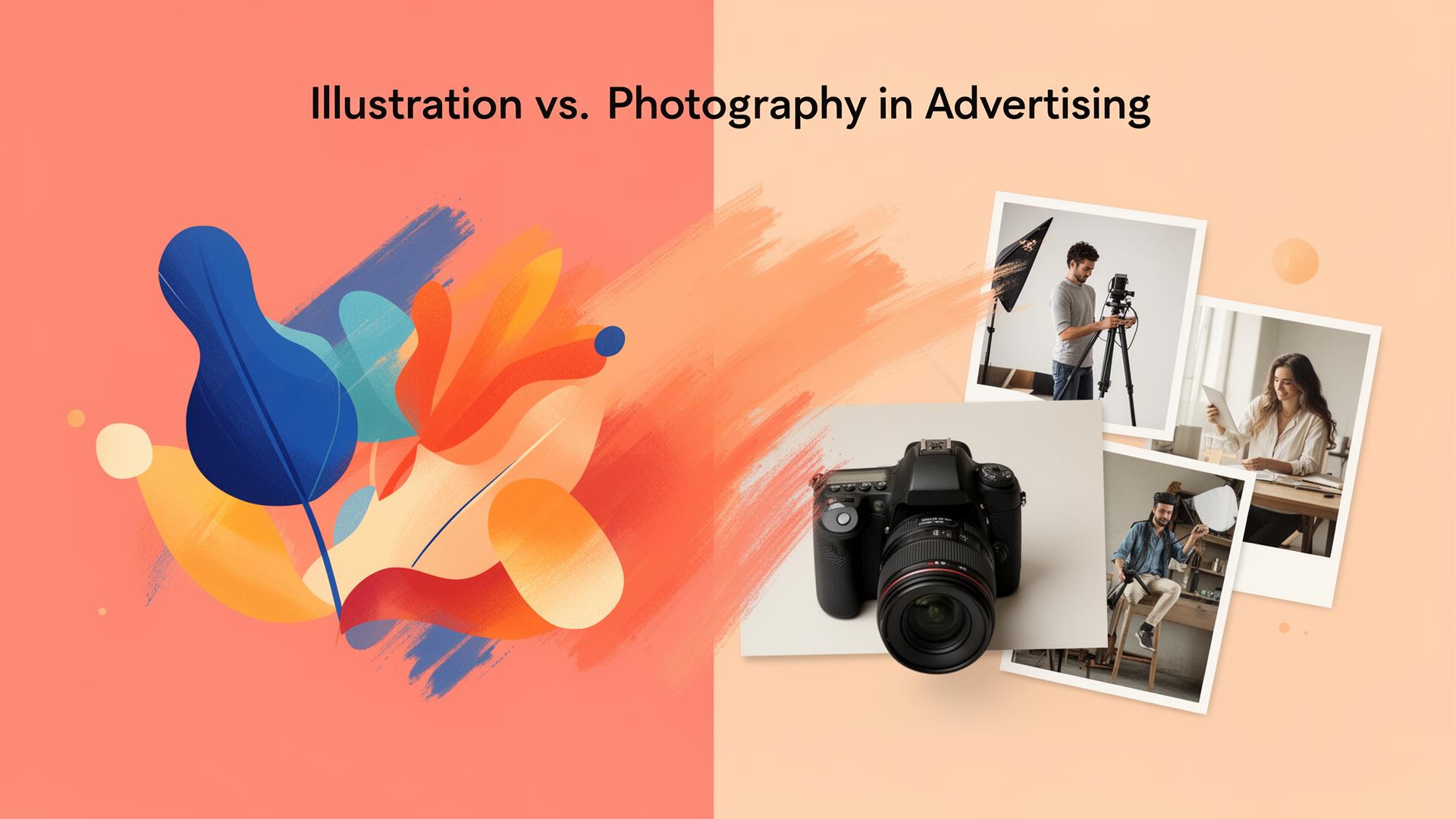
Every creative team has had this debate. You sit down for the kickoff meeting, someone throws the question on the table, and suddenly the entire room is back in Art School Fight Club. “Should we go with illustration or photography for this campaign?”
The truth is simple. It’s not about which style is “better.” That question misses the entire point. Visuals only work when they serve the moment, the audience, and the message. If the style is wrong, the whole thing feels off. Your audience may not know the reason, but they absolutely feel the mismatch.
💬 Good campaigns are visually appealing. Great campaigns feel intentional.
Let’s start simple, because clarity matters.
Illustration refers to custom or semi-custom visuals created from scratch. This includes vector graphics, hand-drawn artwork, digital paintings, and stylized characters. It is crafted entirely through design.
Photography captures real-world imagery through a lens. It includes high-production shoots, lifestyle captures, product photography, and carefully curated stock images.
Neither is inherently superior. They are tools. And like any tool, their effectiveness depends on how intentionally you wield them.
Trying to visualize “data security” or “workflow automation”? Good luck photographing that. Illustration lets you create visual metaphors that communicate ideas a camera simply can’t reach.
When your product is still in development or your brand identity is crystallizing, illustration gives you freedom to explore without locking yourself into visuals that might age quickly.
Some products, such as software, apps, or abstract services, are notoriously difficult to make visually compelling through photography. Illustration creates context and emotion where screenshots fall flat.
When you’re going for whimsy, fantasy, or a distinct creative voice, illustration unlocks possibilities that feel impossible with real-world imagery.
If every competitor is using the same polished stock photography, illustration becomes your competitive edge. It allows you to say: we’re not like everyone else.
💡 Illustration allows intentional exaggeration and storytelling — something AI-generated and stock visuals often flatten into sameness.
Photography carries a different kind of weight. It is tangible, human, and grounded. When your goal is trust or emotional realism, photography wins the moment.
Industries like finance, healthcare, and legal firms need visual credibility. Real people and real environments help communicate reliability.
Physical goods such as food, apparel, and furniture translate clearly through photography. Viewers understand scale, texture, and detail instantly.
Want to capture the joy of a family gathering or the energy of a night out? Photography taps into shared human experiences with immediate recognition.
✨ Photography feels human when it is chosen with care. Generic stock photos undermine that authenticity, so selection matters.
Here’s the quick reference guide for your next creative brief:
| Factor | ✏️ Illustration | 📷 Photography |
|---|---|---|
| Emotional Impact | Conceptual, imaginative, whimsical | Authentic, grounded, relatable |
| Brand Personality | Playful, bold, unique | Trustworthy, professional, real |
| Flexibility | Unlimited — anything is possible | Limited by reality and shoots |
| Production Speed | Moderate (depends on complexity) | Fast (stock) or slow (custom) |
| Cost Range | $$–$$$ (custom work) | $ (stock) to $$$$ (custom shoots) |
| Scalability | Highly scalable, easy to extend | Requires new shoots or licensing |
Context determines which one is more efficient. There is no universal rule.
We’d be remiss not to address the elephant in the room.
Yes, AI can now generate illustrations and photorealistic images at remarkable speed, and technology continues to advance. It also creates new challenges. Here’s what we’ve observed:
AI is a tool. It helps with volume and exploration, but it cannot replace creative direction. It can show you a hundred options. It cannot tell you which one actually serves your campaign goals.
💡 Humans choose why a visual style exists. AI just generates options.
Short answer: Yes.
Hybrid approaches are increasingly common and often incredibly effective:
The key is intentional mixing. Establish a system that explains when and why you’d use each style. Consistency comes from clarity, not uniformity. Intentional mixing, not randomness. Establish a system that explains when and why you’d use each style. Consistency comes from logic, not uniformity.
Here’s the decision framework we use at Creative Shizzle:
There’s no formula that works every time. But these questions will get you 80% of the way there.
We’ve seen these patterns derail otherwise solid campaigns:
There is no single best visual style. What matters is choosing the style that aligns with your brand, your audience, and your goals.
Strong creative work comes from intentional decisions that support the story you want to tell. Illustration and photography are both powerful on their own. Each one brings something different to the table. When you select a style with purpose, your campaigns communicate more clearly and connect more deeply.
💬 Good design is about making choices that serve the work and the humans who experience it.
Creative Shizzle helps brands make design decisions that actually make sense. No jargon. No fluff. Just thoughtful, human-first creative that connects.
Will Novelli is a Happiness Manager at Creative Shizzle, professional Reddit researcher, and community building enthusiast. When he’s not uncovering marketing insights or helping to produce/host Talking Shizzle, you’ll find him exploring Philly’s food scene or crafting the perfect meme. He believes the best marketing happens when real people have real conversations.
Join our mailing list to get our updates and marketing and design tips and tricks.
We use cookies to enhance your browsing experience, serve personalized ads or content, and analyze our traffic. By clicking "Accept", you consent to our use of cookies. You can manage your preferences or withdraw consent at any time.